
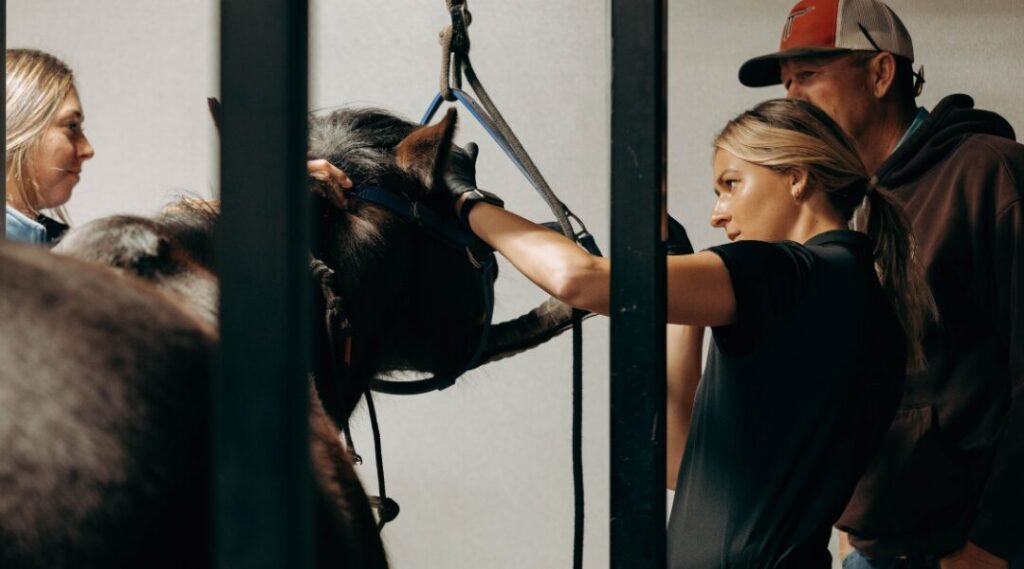
A watery eye. A little squinting. Maybe some discharge after a windy day in the pasture.
It’s easy to assume it’s minor. But according to equine veterinarian Dr. Laura Hanni, those subtle signs can quickly turn into one of the most urgent conditions in equine medicine.
In a recent interview, Dr. Hanni shared that eye ulcers are one of the most commonly underestimated conditions she sees in horses — and one of the fastest to become serious if left untreated. What starts as a small scratch on the cornea can progress within just a couple of days into a deep, painful ulcer requiring surgery.
“The earliest signs are usually squinting, discharge, and obvious discomfort in one eye,” Dr. Hanni explained. “Those are emergencies.”
The challenge is that many ulcers begin from completely ordinary situations. Something as simple as a piece of hay scratching the eye or even dust or debris blowing into the cornea. Because horses spend so much time outdoors, their eyes are constantly exposed to environmental irritation.
Fortunately, early intervention can make an enormous difference. Many ulcers can be treated medically if caught quickly with antibiotic ointments and protective care. But once ulcers become deep or chronic, surgical intervention is often necessary to save the eye and preserve vision.
One of the more fascinating aspects of modern equine ophthalmology is the use of regenerative materials during surgery. In some procedures, veterinarians create a patch using amnion — tissue derived from the mare’s placenta — because of its healing properties and natural stem cells. In more advanced cases, surgeons may use tissue from the horse’s own eye to create a protective graft over the damaged area.
The goal is not only saving the eye itself, but preserving comfort and quality of life. “A successful outcome means the horse is comfortable, pain-free, and still has vision,” Dr. Hanni said. Even if a small scar remains, many horses return to normal function.
Dr. Hanni also discussed another serious equine eye condition: Equine Recurrent Uveitis, often called “moon blindness.” Unlike ulcers, this condition has a stronger genetic component and can cause recurring inflammation inside the eye. One early warning sign owners may notice is the eye beginning to appear cloudy or blue.
Perhaps most impressive is how much equine eye surgery can now be performed with horses standing rather than under full general anesthesia. Because anesthesia carries significant risks for horses, Dr. Hanni and her team often use sedation and regional nerve blocks to safely complete delicate ophthalmic procedures while minimizing recovery complications.
One case in particular still stands out to Dr. Hanni: a recipient mare with a severely damaged eye that was nearly beyond saving. After surgery, the mare healed, retained vision, and eventually went on to carry a successful embryo pregnancy before returning home to her owner.
It’s a reminder that sometimes the smallest signs deserve the quickest attention — especially when it comes to a horse’s eyes.
This post has been approved by Dr. Laura Hanni